
The Lofoten Islands is an outdoor enthusiasts dream destination. A place where the summer’s endless daylight provides the perfect platform for boundless exploration and the winter brings early sunsets and dark skies lit by the dancing colors of the aurora borealis.
In this complete outdoor lovers guide to the Lofoten Islands you will find out everything you need to know before you go and all the best things to do and see once you are there!
LIKE THIS POST? pin it for LATER


We traveled to the Lofoten Islands during the summer months to take full advantage of the outdoor adventures that the islands are known for.
Where are the Lofoten Islands?
The Lofoten Islands is an archipelago located in the Nordland county in Northern Norway. The Lofoten Islands are situated north of the arctic circle with the most popular places to visit being Henningsvær, Reine, Å and Svolvær on the southern end. Below is a Lofoten Islands map which will show you exactly where the archipelago is located in relation to the rest of mainland Norway.
The Top Things to Do in Lofoten Islands, Norway
There are so many incredible things to do and see in the Lofoten Islands that you could easily spend many days exploring the small villages and hiking the many trails. My visit to Lofoten was only 4 shorts days. Luckily I was able to see and do a lot of outdoor activities but I am yearning to return to explore even more! If you can swing a few more days then I would highly recommend it!

Below are some of the top things to do in the Lofoten Islands for adventure and outdoor lovers!
1. Hike to the Top of Reinebringen
Located on the island Moskenesøy, the Reinebringen hike is one of the most iconic hikes in the Lofoten Islands.
Rewarding hikers with the ultimate panoramic view of Reinefjorden and the surrounding fishing villages and mountains it’s no wonder this hike was at the top of our adventure list. While the trail isn’t long, only 3-4 kilometers, it is tough. The trail begins with a somewhat steep, stone plate and then slightly flattens out for a bit while weaving in and out of the trees.


There is no marked path but it is quite easy to follow the trail other hikers have left behind. At the very end, the trail becomes steeper and muddier with lots of loose rocks, turning more into a climb or rock scramble then an actual hike.
This section of the trail is much more difficult so it’s very important to have the right gear while taking your time with foot and hand placement. At a soaring 448 meters, the view of Reine and the surrounding mountains and fjords is worth every nerve-wracking step.


Just over two hours after our feet first touched the trail, we stood at the top enjoying the spectacular views for a while before heading back down.

If you are feeling uncomfortable at any point during the hike, don’t continue. My first attempt at hiking Reinebringen didn’t go so well, however, in an attempt for redemption and some new found confidence I tried again and made it to the top.
How to Get to Reinebringen:
Drive along the E10 towards the village of Reine where there will be a parking lot directly on the corner of the crossroad. From there, walk along the side of the road in the direction of Å, towards the tunnel, where you will round the corner and eventually see the trail head on the outside of the tunnel.
What to Bring for the Reinebringen Hike:
Dress in layers. You may be cold before you start the climb, warm up while hiking and then become cold again once you’ve reached the top. Wear comfortable and sturdy hiking shoes, preferably ones that add extra support to your ankles. Make sure to pack lots of water and a few snacks for energy!
2. Hike to Kvalvika Beach: A Secret Beach in the Lofoten Islands
Having the midnight sun on our side, we started our hike to the secluded Kvalvika beach just around midnight. Depending on what season you visit the Lofoten Island you will want to check the hours of daylight.
Located on the northern side of Moskenesøy and only accessible by foot, the easy, 2km trail begins just across from the small, red boathouse.

Begin by following the path along the planks of wood laid out atop a muddy trail. This path will eventually lead you up and through the over pass to reach Kvalvika beach.


Reaching the top of the trail you will be able to see glimpses of the breathtaking views of Kvalvika Beach. From the top you will begin your descent down towards the beach. The descent is the only “tough” part of the hike as you’ll find yourself climbing over large boulders until you reach the grassy area that meets the golden sandy beach.


You can also hike up another trail towards the summit of Ryten. This trail runs along the south side of the beach and offers some incredible viewpoints looking down over Kvalvika beach. We didn’t do the full hike to the Ryten summit as it was already one o’clock in the morning but if you have more time I would recommend completing the hike.

How to Get to Kvalvika Beach:
Turn off the E10, heading in the direction of Fredvang. You will cross two bridges before reaching Fredvang where you will turn left and follow the road a short distance until you see a small, red boathouse. There will be a small parking area where you can park as long as there is a spot. There is no fee to park here.
3. Go Kayaking in Reinefjorden with Reine Adventures
While the Lofoten Islands is mainly known for their epic hikes and incredible viewpoints another activity for adventure lovers is taking a kayaking tour. We did a 4 hour guided kayaking tour on the Reinefjord with Reine Adventures. The tour costs 1100 NOK ($117 USD) per person and departs from the harbor in Reine.


When you arrive you will assist in carrying your kayak down to the waters edge for a brief introduction. We had one double kayak and single during our trip. After suiting up in the proper attire you will help carry the kayaks along the dock to the launch area and place them in in the water.
You will carefully slide off the edge of the dock and seat yourself into your kayak before lifting the spray skirt up over your lap.

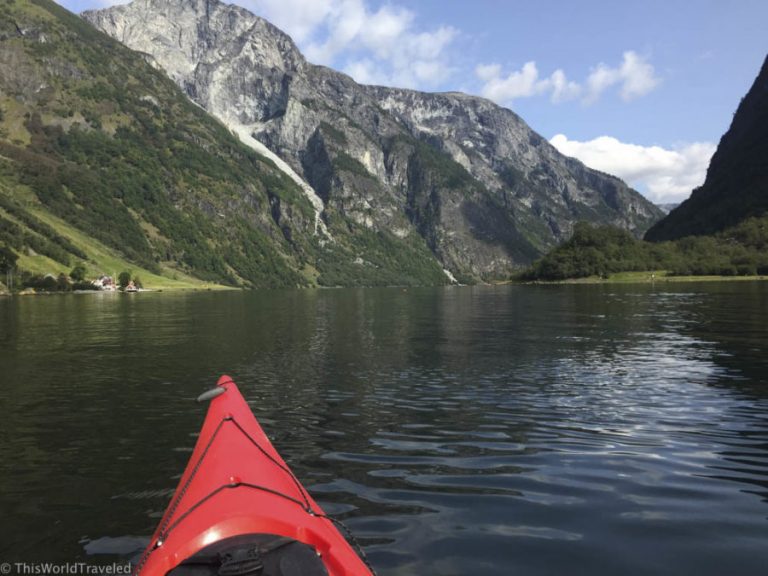
During our kayaking tour we paddled out of the picturesque fishing village of Reine and towards the surrounding mountains into the fjord.
We had high hopes of spotting a pod of orcas, although our guide Emily informed us that they hadn’t seen any in the last couple of days. The summer months provide the highest chance of spotting orcas in the fjords but of course they are wild animals and sightings will always be unpredictable.

Our journey around Reinefjorden and the surrounding area lasted four hours including a stop for lunch. We even kayaked past the Eliassen Rorbuer, or sjøhus, we were staying at in Hamnøy!
During the return journey you will paddle back towards the harbor with the open sea on your left. This is where the wind will pick up and it might become more difficult to keep your kayak pointed in the correct direction.

Eventually you’ll return to Reine where you’ll strategically climb out of your kayak and carry them back to shore. Even though there weren’t any orca sightings, kayaking around the Reinefjorden was 100% worth it for the adventure and the breathtaking views.

What to Bring on a Kayaking Trip in the Lofoten Islands:
Wear waterproof clothing and shoes that can get wet. We were not informed about the proper attire before arriving but luckily they had a few drysuits and booties that we were able to borrow during our trip. Also, be sure to pack your own lunch and plenty of water. And do not forget your waterproof camera or GoPro!
Reine Adventures offers a couple of different kayaking, hiking, biking and overnight camping excursions so be sure to check out their website for more information.
4. Go Horseback Riding with Hov Gård
Situated on the beautiful island of Gimsøy, Hov Gård Riding Centre offers a number of horse back riding trips depending on your experience level. Hov Gård is located in northern Lofoten Islands and is about a 2 hours drive from Hamnøy, which is where we were staying. We booked the Viking Tour which lasts 2.5 hours from 12:30 PM to 2:00 PM. The tours run year round but can be canceled depending on the weather conditions.

We arrived to Hov Gård early so we walked down to the white sandy beach to meet a group of Icelandic horses that call this place home. Once it was time for our riding excursion we headed back up to the stables and met our guides and horses.
Before heading out on the tour you will get a brief introduction and will need to watch a short safety video. The staff will give you proper gear to wear, helmets and boots, and introduce you to your horse. My sweet horse was named Bylur, which translates to Snowstorm, and was the perfect riding companion during the 2.5 hour Viking tour.


Your journey will begin right out of the stables in Hov where you will first trot along the beach by the boathouse before continuing along the old Viking Age Trail and the Gimsøy Nature Reserve. Your guide will lead you along the trail and will also provide information about the history of the area from the Viking Age.

At the end of our horse back riding journey we decided to try a slow trot while we were heading back towards the beach. Even though we were riding the small Icelandic horse a slow trot felt like a fast run and we were quite unprepared for it, especially since my horse would sometimes trip over his own feet!
Slowing back down to a walk we found our way back to the white sandy beach before ending our journey at the stables. We absolutely loved our horse back riding excursion and would recommend it if you wanted to try something unique and fun during your time in the Lofoten Islands.

Would you like to go horse back riding in the Lofoten Islands? Visit Hov Gård to check out all of their riding options!
5. Road Trip Through the Lofoten Islands and Explore the Fishing Villages
The Lofoten Islands is the perfect place to explore by car. The drive from Svolvær offers stunning views of the small, vibrant villages surrounded by turquoise water and imposing mountain cliffs. Around every corner you will be amazed by the beauty of this archipelago in northern Norway.


The main road that cuts through the villages of the Lofoten Islands is the E10. The road is very well maintained and easy to follow with a series of bridges that connect the different islands. If you are arriving at the Svolvær airport you can reserve a rental car which will be the best option for exploring the islands. We rented our car through Hertz and had a very pleasant experience.

A few of the main villages you should visit on a road trip through the Lofoten Islands are:
- Svolvær
- Kabelvag
- Henningsvær
- Hamnøy
- Sakrisøya
- Reine
- Å
- Sund
Tip: To save the map above you can click on the star next to the name of the map!
6. Stay in a Rorbu or Fisherman’s Hut
One of the most iconic things to do during your trip to the Lofoten Islands is to stay in one of the traditional red or ochre colored fisherman huts. As most of the villages in Lofoten are built with direct access to the water these small stilted huts were created so that the local fisherman could row right up their homes.

While traditionally the Rorbuers or Rorbu (singular) were built on stilts sitting half over the water, there are many that are built on solid ground. Many of the Rorbu are surrounded by large racks used to dry the stockfish during the summer months. The fisherman huts and drying racks are some of the things that make the Lofoten Islands so recognizable.

Throughout Lofoten you will find a variety of Rorbuer’s that are available to book for the duration of your stay in the islands. During our time in Lofoten we stayed at Eilassen Rorbuer in Hamnøy. The Rorbu was cozy, idyllic and affordable for our 4 night stay!
7. Visit in the Summer to See the Drying Stockfish
The Stockfish in the Lofoten Islands is dried and matured Arctic Cod (skrei) or Norwegian Arctic Cod. The fish is dried using an ancient, traditional technique that hasn’t been changed for 1000’s of years since the Viking Age. The climate in the Lofoten Islands creates the perfect conditions to dry the stockfish which has allowed them to continue with this method for centuries.

The Arctic Cod is caught from within and around the Lofoten Islands and hung to dry with a very specific process over a period of many months. Once the fish is caught it is immediately cleaned and prepared by removing the head before a few are tied together by their tails.
 The groups of Cod are then attached to the outdoor drying racks where they will be exposed to natures elements such as wind, rain, snow, sun and temperature over a period of many months. Once the stockfish has perfectly dried and maturated it will be removed and packaged to sell. The end of the stockfish season is usually around May and June. We visited at the end of June and were able to see many stockfish still hanging out to dry.
Note: You will need to rehydrate the stockfish prior to preparing it to eat.
How to Get to the Lofoten Islands
While traveling to the Lofoten Islands may seem a bit complicated it is actually relatively easy. There are a few ways you can reach the Lofoten Islands. The most common and time saving option is to take a short hop from the Bodø airport on the mainland. If you have a longer trip planned in Norway you can either drive the whole way or do a combination of driving and taking the ferry.
I will list all of the best options for getting to the Lofoten Islands below!

1. Getting to the Lofoten Islands by Plane
Traveling by plane to the Lofoten Islands is easy, convenient and saves a ton of time!
There are three main airports that service the Lofoten Islands with regular flights coming from multiple locations throughout Norway. Most of the larger Norwegian airports will require a layover in Bodø before continuing on to the Lofoten Islands but it is usually a very short connection.

This means that there are currently no direct flights from Oslo, Bergen, Stavanger, Trondheim or Tromsø to the Lofoten Islands. My flight path to reach the Lofoten Islands was Bergen to Bodø to Svolvær. It was a series of short, easy flights and cost about $500 roundtrip.
Travel Tip: If you are traveling to the Lofoten Islands by plane during the day you should definitely try to get a window seat!
The three main Lofoten Islands airports are:
- Harstad/Narvik Airport Evenes (EVE) – This would be the least recommended airport to fly into for visiting the Lofoten Islands due to its’ location. Once you arrive at the airport you’ll need to drive around 3 hours to reach Svolvær to start your travels around the archipelago.
- Svolvær Airport (SVJ) – The most common Lofoten Islands airport for visitors is Svolvær. This airport connects through Oslo, Bodø, Røst and Stokmarknes. The location of the Svolvær airport is convenient and nearby most of the destinations you’ll want to visit. There are frequent, daily flights traveling to and from Svolvær so you should be able to find many options.
- Leknes Airport (LKN)– Another convenient choice for visitors flying into the Lofoten Islands is the Leknes airport. This airport also offers many daily flights and connects through Bodø, Oslo and Tromsø. Many visitors will also travel through Leknes airport and the rental cars can be slightly cheaper than in Svolvær.
Tip: Airports in Norway are called Lufthavn
The main Norwegian Airlines that fly to the Lofoten Islands airports are:
- Norwegian
- Widerøe
- SAS
2. Getting to the Lofoten Islands by Ferry
You can either drive from your location in Norway to the ferry terminal or take a flight to Bodø. Once you are in Bodø there are a few ways you can travel to the Lofoten Islands by car ferry or boat. From Bodø you can arrive at 3 different locations in the Lofoten Islands: Moskenes, Værøy or Røst. The journey will vary between 3-7 hours depending on your final destination and weather conditions.

The Torghatten Nord company also provides a passenger only journey going from Bodø to Svolvær and you’ll want to check online for the schedule and costs.
You can check the ferry schedule here and book your tickets through the official Torghatten Nord AS website.
Tips for Traveling to the Lofoten Islands Via Ferry
- The journey can be a bit rough so if you suffer from any seasickness I recommend packing some medication.
- Reserve your spot on the car ferry in advance especially if you have rented a car in Bodø. Spots fill up fast especially in the summer months. If you do not have a reservation be sure to arrive at least 1.5 hours prior to departure to see if you can purchase a ticket last minute.
- The current cost is 234 NOK ($24.70 USD) per person for the 3.5 hour journey from Bodø to Moskenes.

Another option to reach the Lofoten Islands by boat is to take the large ship called Hurtigruten. You may have heard of them before as they offer tons of expeditions around the world including Antarctica. They specialize in long journeys with multiple stops but you can also board the boat for a quick trip from Bodø to either Stamsund or Svolvær. The duration is 4 hours to reach Stamsund and 6 hours to reach Svolvær. Prices start at 448 NOK ( $47 USD) per person and reserving a spot is highly recommended.
Good to Know: The different ferry companies might not depart from the same location in Bodø so make sure you know the right location.
3. Getting to the Lofoten Islands by Car
Driving to the Lofoten Islands from mainland Norway would be an incredible experience with magnificent views. However, this is typically recommended for travelers with a bit more time. If you only have 4-6 days in Lofoten I would stick to the flight or ferry route.
If you have 10 days or more to explore Lofoten and are inclined to add an epic road trip into your travel plans than this might be an option for you!

The E10 is the road that runs the entire length of the Lofoten Islands passing through all the picturesque villages. If you are driving from mainland Norway you will be taking the E6 which is the main route from south to north. The E6 connects with the E10 in Bjerkvik and from there you will begin to head down south within the Lofoten Island Archipelago.
Good to Know: Even if you fly or take the ferry to the Lofoten Islands you will want to rent a car once you are there to travel around and explore. The public transportation system isn’t designed as a hop-on, hop-off bus but is more of a get from point A to point B situation.
Lofoten Islands Weather & When to Visit
The Lofoten Islands weather is quite mild considering its’ location north of the Arctic circle. Even during the winter months the temperatures rarely dip below freezing which is due to the Gulf Stream. However, just like most destinations in the north the weather can be unpredictable and it is always best to be prepared. The Lofoten Islands has a similar climate to Iceland even though it is much farther north.


There will be a few factors that determine when exactly you’ll want to travel to Lofoten and these are decisions are completely personal.. Maybe you want to maximize your hours in the day from the midnight sun. Or maybe you are hoping to see the northern lights dance in the sky. These things will help you decide when is the best time for you to visit the Lofoten Islands.
Winter in the Lofoten Islands:
The winter season typically lasts from October until March with the coldest and shortest days running from December through February. The upside to the limited daylight and dark nights is that you’ll have approximately 182 days of possible northern lights sightings. Keep in mind though that spotting the northern lights is very dependent on the weather. Another plus side to experiencing Lofoten in the winter is you will see the beautiful villages covered in a blanket of snow making it a magical winter wonderland. In the winter you will see less crowds and the cost for accommodation and rental car will be slightly cheaper than during the summer months.
» Must Read: A Complete Guide to Photographing the Northern Lights

Summer in the Lofoten Islands:
The summer season in the Lofoten Islands goes from June to August. This is a very short summer by most standards but it provides visitors with almost 24 hours of daylight and warmer weather. In fact, there are 49 days of the midnight sun in the Lofoten Islands. The only downside to visiting during the summer is the high number of visitors. Although we were there near the end of June and rarely ran into other tourists. The temperature during the summer is warmer and the islands experience the least amount of rainfall during these months. This makes the summer months a prime time for visitors who are wanting to partake in the many outdoor activities such as camping, biking, hiking and kayaking. Just know that you will not be able to see the northern lights during the summer in Lofoten.
If you are planning to visit the Lofoten Islands in the summer it is best to reserve your accommodation and rental car far in advance. Also keep in mind that the prices will be slightly higher than during the fall, spring or winter.

Fall in the Lofoten Islands:
The fall season in the Lofoten Islands last from late August until mid-October. The benefit of visiting in the fall is less crowds and cheaper rates while still having plenty of daylight and warmer weather than during the winter. You may even get to experience the northern lights however, fall is when the Lofoten Islands will see an increase in rainfall.
Spring in the Lofoten Islands:
The spring season in the Lofoten Islands runs from March through May. In the first few months of spring you may be able to see the northern lights if the weather cooperates. I’ve been fortunate enough to see the northern lights multiple times in March but it was in Tromsø, Norway not in Lofoten. If you visit in early spring you will probably still see Lofoten covered in snow and if you visit in late spring you’ll be there for the beginning of the midnight sun.
Good to Know: The least expensive months to visit the Lofoten Islands is during the fall or spring (shoulder seasons). The shoulder season is either March and April or August and September.

Where to Stay in the Lofoten Islands
There are a number of highly rated hotels and guesthouses available in the Lofoten Islands for all different budgets. During our time in the Lofoten Islands we stayed in one of the traditional red fisherman cottage called a Rorbu or Rorbuer (plural).

The Robu we stayed at was called Eliassen Rorbuer and is located in Hamnøy. The view of Eliassen Rorbuer from the bridge is one of the most photographed spots in Lofoten.
If you are up for a bit more adventure you can explore the Lofoten Islands by camper van!
Like this post? Pin it for later!


WHAT CAMERA GEAR DO I USE?
» Click HERE for the Full Travel Photography Gear Guide to see what’s in my camera bag!
- Main Camera: Sony A7III
- Wide angle lens: Sony G Master 16-35mm f/2.8
- Zoom lens: Sony 24-240mm f/3.5-6.3
- Prime lens: Sony 85mm f/1.8
- Secondary Camera: Canon 6D Mark II
- Canon wide angle lens: Canon EF 17-40mm f/4L
- Canon lens: Canon EF 24-70mm f/2.8L
- Underwater camera: Leica X-U
- Camera with gimbal: DJI Osmo Pocket & Underwater Housing
- Drone: DJI Mavic Pro 2
- Camera Bag: Polar Pro Drone Trekker
- External Hard Drive: LaCie 2 TB rugged mini external hard drive

Wow, I envy you for this. I used to be a mountaineer but due to hectic schedules, I could no longer tag along with my peers. It’s a good thing that you can still explore the true beauty of the world