Planning your ultimate Croatia itinerary? Combine it with a road trip through Croatia, as well as Bosnia and Herzegovina to experience the best of the Balkans. From seaside villages and medieval cities to cascading waterfalls and charming mountain towns, this 8-day route offers the perfect mix of history, nature, and adventure.


*Disclaimer: This post may contain affiliate links. Please see the full Disclosure Policy for details and as always, thank you for your support.
Places to Visit in Croatia & Bosnia
Your 8 day road trip will start and end in the charming coastal city of Zadar, where you’ll pick up your camper van and hit the road for an unforgettable adventure. Traveling by camper offers the freedom to explore at your own pace. A road trip through Croatia and Bosnia delivers coastal views, historical cities, cultural experiences and delicious cuisine!
Day 1: Arrive in Zadar and travel to Split
If you are renting your camper van through Your Way Campers you’ll most likely begin your trip out of Zadar. They do offer alternative pick up locations for an extra charge. Once you pick up your rental, drive to Split where you’ll stay the night at a nearby campground or AutoCamp. We stayed at Camping Stobreč Split which cost about €35 for the night.
Day 2: Explore Split and drive to Dubrovnik via Omiš
First up on your Croatia itinerary is Split, a coastal city with a lot of history and charm. In the city center you’ll find the stunning Diocletian’s Palace, a UNESCO World Heritage Site of Roman ruins. Surrounding the palace are narrow cobblestone streets lined with cute cafes, local shops and lively bars. Plan on strolling along the popular Riva promenade, explore the local markets, or climb up Marjan Hill or some panoramic views. With its crystal-clear Adriatic waters, easy access to nearby islands, and a rich mix of culture, food, and seaside relaxation, Split is an absolute must on your Croatian road trip.


Departing from Split you can choose two different ways to reach Dubrovnik for your Croatia itinerary. We suggest the coastal route. It’ll add about 45 minutes to an hour onto your drive time but it is well worth it for those seaside views. Along the way you can stop in some of the smaller, less touristy towns to grab lunch and explore. We passed through Omiš and stopped at Milo Restaurant for lunch.
Omiš, Croatia is a charming seaside town situated between dramatic cliffs and the Adriatic Sea, just a short drive from Split. We ended up passing back through Omiš after our time in Bosnia so we will share more things to do here later.

You’ll arrive in Dubrovnik later in the evening so depending on your arrival time you may just want to head straight to the campground. We stayed at Camping Solitudo and it was our least favorite AutoCamp of the whole trip. However, it was the closest campground to the Old Town Dubrovnik which made it more convenient.
Day 3: Spend the day in Dubrovnik
Start your day early and spend the whole day wandering around the Old Town of Dubrovnik. Driving close to the Old Town is not recommended so it’s best to park at Grand Parking Dubrovnik and either walk the rest of the way or take the public bus.


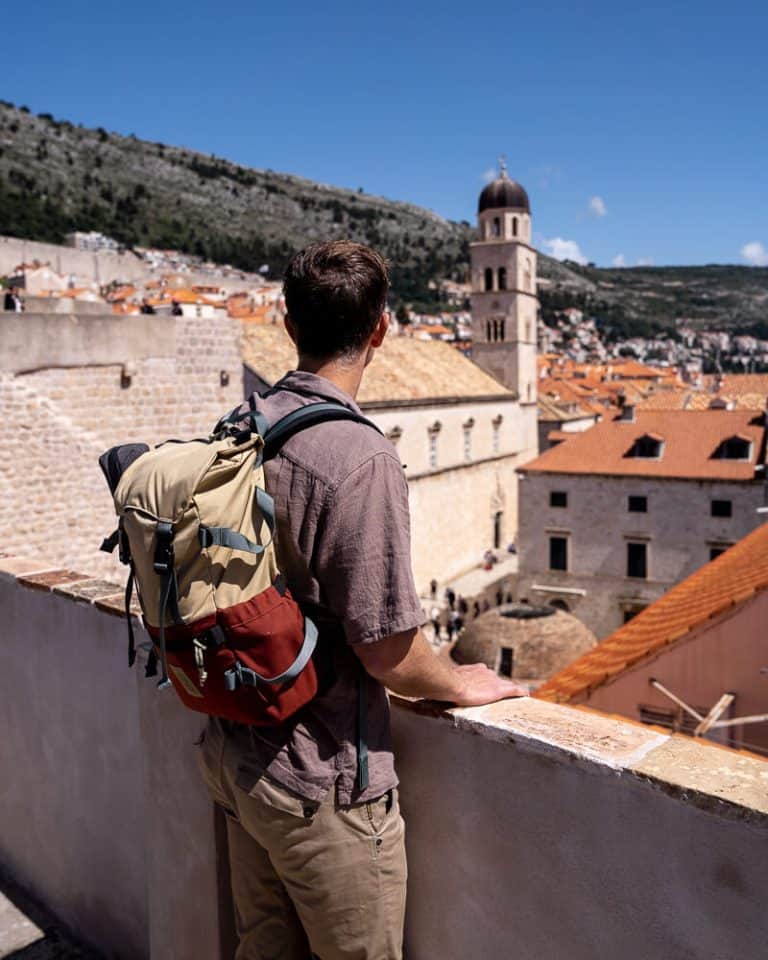
Dubrovnik, Croatia is one of the most iconic and picturesque destinations along the Adriatic coast, often referred to as the “Pearl of the Adriatic.” This city is known for its remarkably preserved medieval Old Town, surrounding stone walls and orange roofed houses.
Fans of Game of Thrones will instantly recognize Dubrovnik as the filming location for King’s Landing, the capital of the Seven Kingdoms. Throughout the city, you’ll find filming locations from the hit HBO series, including Fort Lovrijenac, the Jesuit Stairs, and parts of the city walls. We’ve never actually seen the show but for fans, seeing these locations in real life would be pretty spectacular.

Best things to do in Dubrovnik:
- Walk the City Walls – One of Dubrovnik’s most famous experiences, this 1.2-mile loop offers stunning views of the Old Town, Adriatic Sea, and surrounding fortresses.
- Visit Fort Lovrijenac – Known as “Dubrovnik’s Gibraltar,” this impressive cliffside fort also doubled as the Red Keep in Game of Thrones.
- Explore the Old Town – Wander through limestone streets, admire Baroque architecture, and discover charming shops and cafés in this historic heart of the city.
- Take a Cable Car to Mount Srđ – Ride to the top of Mount Srđ for panoramic views over Dubrovnik and nearby islands, especially beautiful at sunset.
- Tour the Rector’s Palace and Dubrovnik Cathedral – Understand the city’s rich history with visits to its’ most important cultural and religious landmarks.
- Relax at Banje Beach – Just outside the city walls, this popular beach is perfect for swimming and sunbathing with a view of Dubrovnik’s skyline.
- Go Island Hopping to Lokrum or the Elafiti Islands – Take a boat trip to nearby Lokrum Island or explore the quieter, scenic Elafiti archipelago.
- Join a Game of Thrones Tour – Take a guided walking tour focused entirely on Game of Thrones filming locations and behind-the-scenes stories.
To end the day, you’ll head to your next camping spot: Camping Kate. Day 4 will have you crossing the border into Bosnia.
Day 4: Cross the border into Bosnia
Start your morning with a border crossing from Croatia into Bosnia. You’ll need your passport only to cross from Croatia to Bosnia. However, you’ll need a “green card” from your rental car. The ‘green card’ is a white piece of paper that you will need to show to a border agent for proof of insurance.
If you’re a wine connoisseur your first stop should be to Vinarija Bojanic.


Spend the rest of your afternoon in Stolac, a small, culturally rich town in Southern Bosnia and Herzegovina. Situated along the Bregava River, Stolac is surrounded by rugged hills and full of unique Ottoman-era architecture. The town is most famous for the Provalije waterfall that runs through the Stolac Minica Old Mill. This quaint town is worth passing through but other than viewing the waterfall there isn’t much to do.


After a short visit in Stolac, drive 35 minutes to the small town of Blagaj. Here you can camp at River Camp Aganovac which is a short walk from the main things to see and do in Blagaj.
Day 5: Explore Blagaj and Mostar, Bosnia & Herzegovina
You’ll want to begin your day early because this area is a pretty popular tourist destination and the buses start arriving around 10:30 AM.

Tucked against a cliff just outside of Mostar, the tiny village of Blagaj is home to one of the most peaceful and picturesque spots in all of Bosnia, Vrelo Bune and the Blagaj Tekke. The Buna River emerges out of a cave beneath a towering rock wall, and right next to it sits a centuries-old Dervish monastery.
The monastery was built during the Ottoman era and was once a retreat for Sufi monks. It is an incredibly peaceful setting and such a unique place. While it is possible enter the monastery, we decided to skip it and only see it from the opposite site of the river. There are some cafes and restaurants that line the river, so if you’re looking to grab a bit this is a good spot.


After your visit in Blagaj, you’ll drive 20 minutes to Mostar, one of Bosnia’s most popular and iconic cities.
Mostar is a city that needs be included in your Croatia & Bosnia itinerary. Enjoy the mix of Ottoman and Austro-Hungarian architecture, the turquoise river, and the iconic Stari Most (Old Bridge). The bridge is definitely the main attraction and what most people recognize about Mostar. It was originally built in the 1500s, destroyed during the war in the ‘90s, and then carefully reconstructed stone by stone.

While it’s not recommended, you sometimes will see locals diving off the bridge into the Neretva River below. If you really want to see Mostar from the river, we recommend jumping into one of the rigid inflatable boats for a quick zip on the water.


But Mostar is more than just its famous bridge. Wandering through the cobblestone streets of the Old Bazaar, you’ll pass stalls selling jewelry, rugs, Bosnian coffee and €2 beers. Don’t miss the Koski Mehmed Pasha Mosque where you can climb the minaret for unreal panoramic views of the bridge and city. And if you’re into history, the Museum of War and Genocide Victims offers sobering but important context on the city’s recent past.
After Mostar, you’ll drive one hour to Kravica waterfall and camp overnight.
Day 6: Visit Kravica Waterfall, drive back into Croatia and hike in Omiš
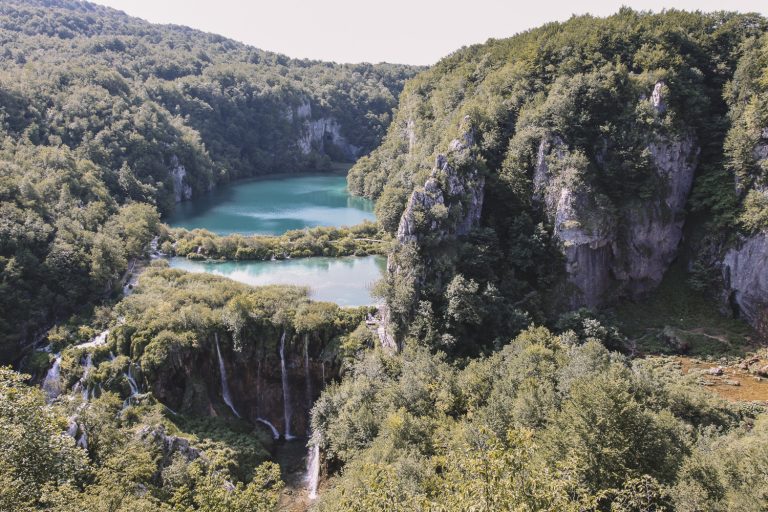
Kravica Waterfall is sort of like a smaller version of Krka or Plitvice Lakes in Croatia. Tucked away in the Bosnian countryside, about 40 minutes from Mostar, this natural wonder features a stunning 28-meter cascade that flows into an emerald pool. Surrounded by trees and moss-covered rocks, it’s a popular place for locals and tourist alike. You can even swim in the falls! Entrance to Kravica waterfall costs 20 KM ($11.60 USD) per person, as well as a small fee for parking.


There are a couple of small cafés nearby where you can grab a cold drink or snack, and you can rent paddle boards or take a short boat ride if you want a closer look. It’s relaxed, beautiful, and definitely feels like a hidden gem.
After a short visit to Kravica, drive 1.5 hours back to Omiš. While it’s not ideal to start a hike during peak sun, we wanted to make the most of our time.

End your day by driving 1 hour 20 minute to Šibenik so you can wander around the coastal town early in the morning.
Day 7: Explore Šibenik, Croatia and end your day wandering around Zadar
While the city of Šibenik might not have been on your Croatia itinerary, it absolutely should be. This turned out to be one of our favorite small towns along the coast of Croatia. Tucked between Split and Zadar, about a 3.5-hour drive from Dubrovnik, Šibenik is full of charm, history, and stunning coastal views without the crowds.

Explore the stone alleyways in the Old Town, visit the impressive Cathedral of St. James, and climb to the top of St. Michael’s Fortress for panoramic views over the city and sea.


Departing Šibenik, you’ll drive one hour to reach Zadar. There is plenty of parking outside the pedestrian only Old Town where you can leave your camper van or car for a few hours.
Day 8: Spend the morning in Zadar and go home
This is the last stop on your Croatia itinerary and where you’ll drop off your rental car or camper van and head home.


Wander through Roman ruins, climb the bell tower of St. Anastasia’s Cathedral for panoramic views, and weave through the marble streets of the Old Town. One of Zadar’s most famous and fascinating attractions is the Sea Organ, an architectural sound art installation built into the waterfront that plays music created by the movement of the sea. As the waves push air through underwater pipes, the steps along the promenade create unique musical tones. Nearby, the Sun Salutation light installation comes alive after dark in a colorful display powered by solar energy.
How to get around during your Croatia itinerary
When planning your Croatia itinerary, one of the best ways to explore both Croatia and Bosnia and Herzegovina is by renting a car. Having your own vehicle gives you the freedom to travel at your own pace and access coastal drives, inland villages, and off-the-beaten-path places. The roads between major cities like Split, Dubrovnik, Mostar, and Sarajevo are generally well-maintained and easy to drive along.


In some parts of Bosnia you may encounter some unpaved roads but a standard vehicle or camper van will be just fine. Also, like many countries in Europe the streets can be quite narrow in some spots so know the limitations of your vehicle.
Tip for renting a car
While not all countries require it, you should see whether an International Driver’s License is required for renting a vehicle. If you live in the United States you can easily get one from your nearest AAA.
When renting a vehicle double check to make sure that you are booking either manual or automatic transmission. Manual transmission is more popular in Europe. Also, note whether the fuel is diesel or petrol.
Is it safe to drive in Croatia & Bosnia?
Yes, it’s generally safe to drive in both countries. Roads are well-maintained, especially in Croatia and easy to navigate. Driving in the larger cities, like Dubrovnik can be a little challenging so it’s better to park slightly farther away. While planning your Croatia itinerary, you’ll likely consider crossing into either Bosnia or Montenegro. Bosnia’s mountain roads can sometimes be narrow, but they are manageable, even in the camper van.


While it is always best to do so, stick to daylight driving if you can. The road signs are easy to understand and remember that you yield at roundabouts. In Croatia and Bosnia, they drive on the same side of the road as in North America.
If you’re traveling in a vehicle without a GPS we would recommend getting an eSIM for your phone. This way you’ll be able to use Google Map or some other type of navigation during your Croatia itinerary.
Crossing the border between Croatia & Bosnia
Border crossings between Croatia and Bosnia are pretty straightforward. You’ll need your passport and, if using a rental car, a “green card” (international insurance proof) which is in the form of a white piece of paper. Your rental company should show you that paperwork beforehand.

Be prepared for long delays at the border during peak travel times. We didn’t have any issue or delays crossing into Bosnia. However, we did attempt to cross the border from Croatia into Montenegro and the line was so long we decided to skip it. When we crossed the border from Bosnia to Croatia we did have to show them our “green card” and declare any alcohol.
Best time of year for a Croatia & Bosnia road trip
The best time of year to go on a Croatia & Bosnia road trip is from May to October, when the weather is warm, the skies are clear, and the roads are easily accessible. During this period, you’ll enjoy long daylight hours that are perfect for exploring the coastal towns, national parks, and historic sites. July and August are the peak summer months, offering the hottest weather and the fun festivals or events. However, they also come with heavier crowds and higher accommodation prices.


If you’re looking for a more relaxed experience, the shoulder seasons of May–June and September–October are ideal. The warm temperatures are more pleasant, without the summer rush. This makes it easier to find parking, get last-minute accommodations, and enjoy popular spots like Dubrovnik’s Old Town or Mostar’s famous bridge with fewer tourists around.
This is also a great time to visit if you love nature, as wildflowers bloom in the spring and the Adriatic Sea stays warm enough for swimming well into the fall. Whether you’re hiking, sightseeing, or just enjoying your road trip, this time of year offers the perfect balance for an adventure through Croatia and Bosnia.
Does my rental car allow crossing borders in the Balkans?
Not all rental companies allow cross-border travel. Confirm in advance and ensure you have:
- A green card for Bosnia
- Necessary paperwork from the rental company
- Optional GPS or local SIM card
- Your passport
Where to camp during your road trip
Camping in Croatia and Bosnia and Herzegovina is a fantastic way to experience the beauty of the Balkans but it does come with some important rules to keep in mind. First and foremost, wild camping is illegal in both countries and strictly enforced, especially in national parks and along the coast. It’s best to stay in designated campgrounds, which are widely available and often scenic in ideal locations.

Campsites in both countries are generally well-equipped, with prices ranging from €15–€40 per night depending on the location, season, and amenities offered. Most campgrounds provide essentials like electricity, restrooms, showers, and Wi-Fi, and many also offer extras such as laundry facilities, small restaurants, and communal kitchens. Make sure you have some euro cash on you as many campgrounds do not take credit card.
Campground Rules
Not all, but many of the AutoCamps or campgrounds do collect your passport overnight as an ‘insurance’. It is common practice in both Croatia and Bosnia.
During peak summer months (July and August), it’s a good idea to book in advance, especially for popular coastal spots or near national parks like Krka or Plitvice in Croatia.


That said, many campgrounds do accept late arrivals and have posted instructions for check-in after hours, just be sure to check their policies ahead of time if you plan to arrive late. Since we were traveling during off-peak season we did not need to make advanced reservations and had good luck getting a spot last minute.